When spirocycles become metabolic soft spots
By Julia Shanu-Wilson
Spirocycles can bring valuable three-dimensionality, tune physicochemical properties and even improve metabolic stability. But what happens when the spirocycle itself becomes a weak point? Muvadenant offers an intriguing case study, with metabolism studies revealing oxidative ring opening across two different ring systems. In this article, we explore how these rings might be metabolised and ask what this means for medicinal chemists designing metabolically robust drug candidates using these moieties.
Metabolic ring opening of spirocycle-containing drugs
Spirocycles are often introduced into drug candidates to improve three-dimensionality, alter physicochemical properties and, in some cases, enhance metabolic stability. But what happens when the spirocycle itself becomes the metabolic soft spot? Recent studies of muvadenant provide an intriguing example [1].
Metabolism of muvadenant in human hepatocytes and in vivo in rats revealed oxidative ring opening across two different ring systems, as well as Phase II conjugation.
Key biotransformations observed:
- Oxidative ring opening of the tetrahydropyran (oxane) ring of the 7-oxa-2-azaspiro[4.5]decane system to open-chain metabolites M11 and M2 in human hepatocytes and in rats in vivo, and to M29 in rats.
- Oxidative ring cleavage of the C7 dihydropyran ring substituent followed by sulfation to M28 in rats
- Oxidation of the C7 dihydropyran ring substituent to a lactone (M22, and M2, in which the spirocyclic ring is also opened)
- O-demethylation of the methoxy group on the thiazolopyridine core to M1 in rats
M11 and M2 are highly oxidised, ring-opened metabolites, their formation consistent with pathways involving sequential hydroxylation and further oxidation, with M13 representing a possible intermediate (Figure 1).
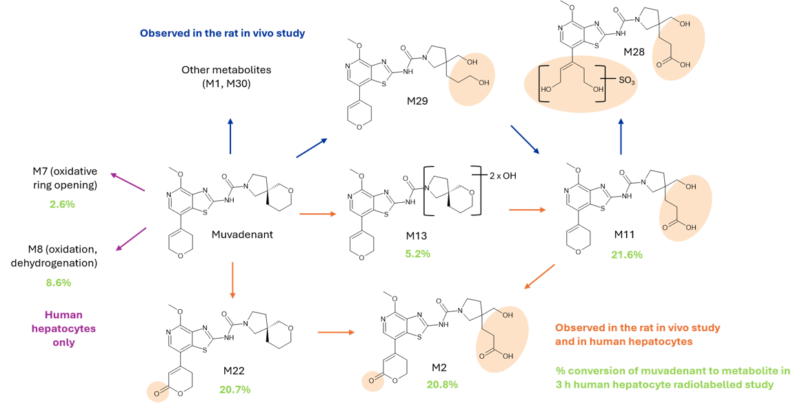
Figure 1: Metabolic map of muvadenant illustrating metabolism driven spirocycle ring opening (Adapted from Figure 4 in [1])
What enzymes are involved?
Oxidative ring cleavage is a relatively common metabolic biotransformation, often involving cytochrome P450 enzymes such as CYP3A4 but also CYP2B6, CYP2C19 and CYP2D6. CYP3A4 is recognised as a broad-spectrum ring oxidiser. It is particularly well known for involvement in opening of simple morpholine and piperazine ring systems where the enzyme initiates cleavage by performing an α-carbon hydroxylation which can destabilise the ring and, following C–N cleavage, can generate open-chain carbonyl-containing metabolites. In contrast, more complex spirocyclic ring systems are composed of two rings joined at a single shared spiro atom, typically a quaternary carbon, and their metabolism consequently can differ from simpler ring systems.
Spirocyclisation can increase metabolic stability by altering molecular conformation and steric accessibility, potentially shielding otherwise susceptible C–H bonds [2]. Changes in lipophilicity and enzyme recognition can also contribute, although the effect is highly scaffold-dependent. The literature highlights key mechanisms where biotransformation of spirocycles can occur:
- Hydroxylation without ring cleavage
- Ring-opening via carbonyl intermediates, where a heteroatom sits adjacent to a carbon α to the spiro centre.
- Ring opening following hydroxylation, with collapse of the intermediate to give a linear chain attached to the surviving ring.
Cytochrome P450 enzymes are frequent initiators of oxidative spirocyclic ring-opening pathways. CYP3A4 is the primary enzyme responsible for the initial oxidation that causes the destabilisation of the piperidine ring in the rigid, conformationally restricted spirocycle core of a potent substance P (neurokinin 1, NK1, receptor) antagonist, eventually resulting in formation of a major circulating keto acid metabolite [3].
Vulnerability of strained spirocyclic systems
Sometimes highly strained spirocyclic systems such as spiro-azetidines or spiro-oxetanes can undergo unusual, highly specific ring-opening reactions. Such is the case with AZD1979 where a glutathionyl conjugate M12, formed in human hepatocytes, resulted from glutathione S-transferase (GST)-catalysed glutathione attack on the carbon atom α to the nitrogen atom of the strained azetidine ring of the 2-oxa-6-azaspiro[3.3]heptane system (Figure 2). After ring opening this generated an amino-thioether conjugate product without prior bioactivation by cytochrome P450s [4].
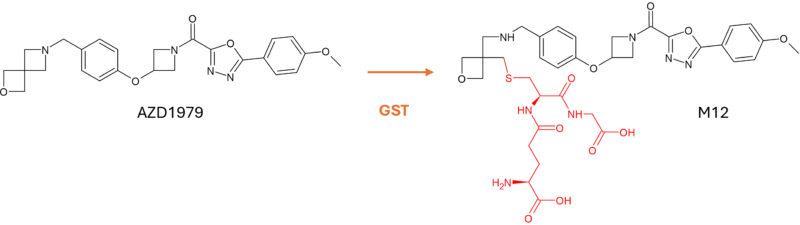
Figure 2: Metabolism of AZD1979 to a glutathionyl conjugate M12
Are unstrained spirocycles more resistant to metabolic attack?
Although unstrained spirocyclic compounds such as muvadenant are generally more resilient to the structural collapses seen in morpholine or highly strained ring systems, literature shows that under protracted CYP-mediated oxidation, these moieties can undergo distinct, localised ring-opening pathways.
The pyrrolidine ring has been reported to be the focus of oxidation and ring opening in some molecules. One established pathway involves CYP-mediated α-hydroxylation adjacent to nitrogen, generating an unstable carbinolamine that can undergo C–N cleavage. This converts the pyrrolidine ring into an open-chain secondary amine with a terminal aldehyde group, which can be further oxidised by aldehyde dehydrogenase to the corresponding carboxylic acid.
Ring opening is observed for the unstrained 7-oxa-2-azaspiro[4.5]decane ring system in muvadenant, but with opening of the tetrahydropyran ring rather than the pyrrolidine ring. Opening of this six-membered ring is initiated through α-hydroxylation at carbons flanking the oxygen. Subsequent ring collapse converts the ring into a linear chain bound to the quaternary carbon of the surviving pyrrolidine ring, terminating in a primary alcohol (M29) or, after further oxidation, a carboxylic acid (M11 and M2).
Muvadenant has been reported to be a CYP3A4 substrate and interestingly also acts as an inducer of CYP3A4 [5]. Clinical data suggest dose-dependent autoinduction of CYP3A4, which was hypothesised to contribute to the less-than-dose-proportional increase in exposure observed at higher doses. Muvadenant has also been described as a direct and time-dependent inhibitor of CYP3A4, highlighting the complex interplay between its metabolism, inhibition and induction of this enzyme.
For medicinal chemists, this is a useful reminder that metabolic stability cannot always be predicted from the apparent robustness of a ring system alone. Sometimes, even seemingly stable ring systems can become sites of metabolic opening and biotransformation.
References
[1] Nachtigall J, Maurer CK, Lecomte M, Schiemann K, Zaynagetdinov R, Reuter T, et al. Preclinical pharmacokinetics and biodistribution of the dual adenosine A2A/A2B inhibitor muvadenant (M1069) in rats. Xenobiotica. 2026:1–10. doi: 10.1080/00498254.2026.2720770.
[2] Varela MT, Dias GG, de Oliveira LFN, de Oliveira RG, Aguiar FD, Nogueira JP, et al. Spirocyclic compounds as innovative tools in drug discovery for medicinal chemists. Eur J Med Chem. 2025 Apr 5;287:117368. doi: 10.1016/j.ejmech.2025.117368.
[3] Hop CE, Wang Y, Kumar S, Elipe MV, Raab CE, Dean DC, et al. Identification of metabolites of a substance P (neurokinin 1 receptor) antagonist in rat hepatocytes and rat plasma. Drug Metab Dispos. 2002 Aug;30(8):937-43. doi: 10.1124/dmd.30.8.937.
[4] Li XQ, Grönberg G, Bangur EH, Hayes MA, Castagnoli N Jr, Weidolf L. Metabolism of Strained Rings: Glutathione S-transferase-Catalyzed Formation of a Glutathione-Conjugated Spiro-azetidine without Prior Bioactivation. Drug Metab Dispos. 2019 Nov;47(11):1247-56. doi: 10.1124/dmd.119.088658.
[5] Siu LL, Gutierrez ME, Pudelko L, Ruth K, Filho MAFN, Zaynagetdinov R, et al. First-in-human study of the dual A2A/A2B adenosine receptor antagonist muvadenant (M1069) in patients with advanced solid tumors. ESMO Open. 2026 May;11(5):106962. doi: 10.1016/j.esmoop.2026.106962.