Paper Pick – The role of metabolites in drug-drug interactions
Our last paper pick of the year is an excellent discussion by Nina Isoherranen on the role of metabolites in DDIs (drug-drug interactions) [1]. The paper highlights key areas where consideration should be given:
- Reversible inhibition of CYPs (Cytochrome P450 enzymes)
- TDI (time dependent inhibition) of CYPs
- Inhibition of transporters
- CYP enzyme induction
Analysis reveals that in many cases the metabolite can be more important in the DDI than the parent drug, or where the DDI profile of the parent and the metabolite is completely different.
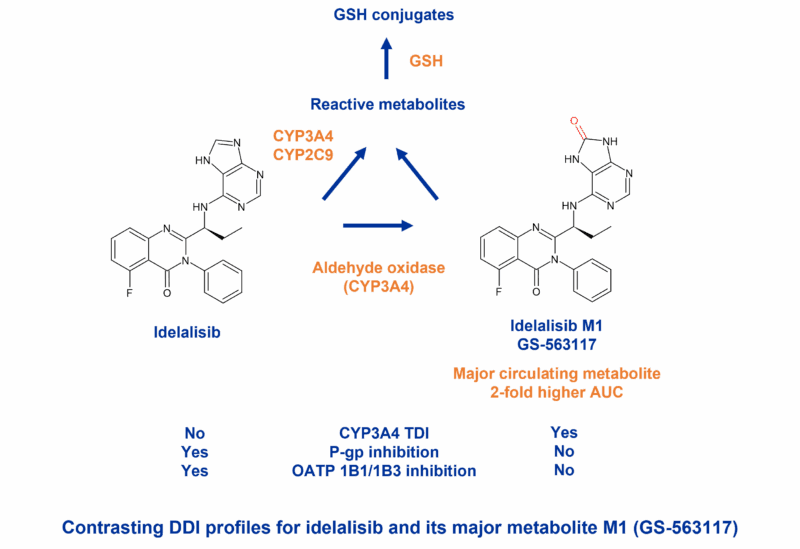
One interesting example cited is the drug idelalisib which has a black box warning due to hepatotoxicity, likely due to reactive metabolites formed in the liver from both the parent drug and its major circulating metabolite M1 (GS-563117) [2]. M1 is formed predominantly by aldehyde oxidase and circulates at 2-fold higher than the parent drug in humans. It is a TDI of CYP3A4, in contrast to the parent which does not inactivate CYP3A4 but does inhibit P-gp (P-glycoprotein) and OATP (organic anion transporting polypeptide) 1B1 and 1B3.
It’s not just Phase I metabolites that are implicated in DDIs. Phase II metabolites such as acyl glucuronides can also be involved in DDIs, such as that caused by TDI of CYP2C8 by gemfibrozil acyl glucuronide. Gemfibrozil itself does not inactivate CYP2C8, and in-vitro is a more potent inhibitor of CYP2C9.
It’s worth noting that there has been far less attention paid to the potential risk of metabolites inhibiting drug transporters, despite their more polar nature, and likely higher affinity to, or more reliance on, such transporters for their clearance. The paper highlights that further studies in this area are urgently needed.
Emphasis is placed on a need to design clinical DDI assessment strategies bearing in mind that the enzyme and transporter inhibition profiles of any relevant metabolites is independent of the parent drug and its DDI profile.
Papers
[1] Nina Isoherranen. Role of Metabolites in Drug-Drug Interactions. Drug Metabolism and Pharmacokinetics, 2025, 101511, https://doi.org/10.1016/j.dmpk.2025.101511.
[2] Zhu J, Wang P, Shehu AI, Lu J, Bi H, Ma X. Identification of Novel Pathways in Idelalisib Metabolism and Bioactivation. Chem Res Toxicol. 2018;31(7):548-555. doi:10.1021/acs.chemrestox.8b00023