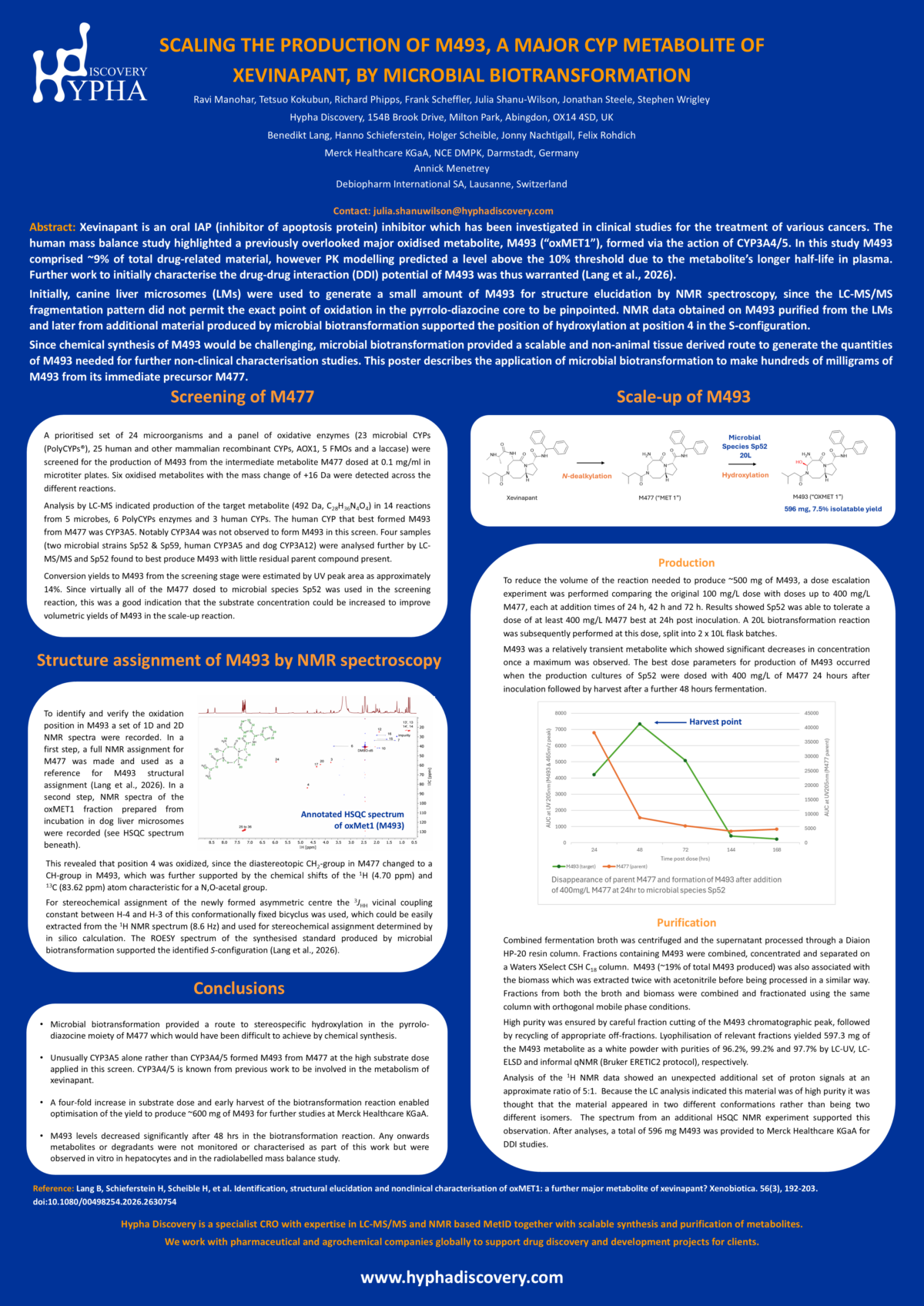

Xevinapant is an oral IAP (inhibitor of apoptosis protein) inhibitor which has been investigated in clinical studies for the treatment of various cancers. The human mass balance study highlighted a previously overlooked major oxidised metabolite, M493 (“oxMET1”), formed via the action of CYP3A4/5. In this study M493 comprised ~9% of total drug-related material, however PK modelling predicted a level above the 10% threshold due to the metabolite’s longer half-life in plasma. Further work to initially characterise the drug-drug interaction (DDI) potential of M493 was thus warranted (Lang et al., 2026).
Initially, canine liver microsomes (LMs) were used to generate a small amount of M493 for structure elucidation by NMR spectroscopy, since the LC-MS/MS fragmentation pattern did not permit the exact point of oxidation in the pyrrolo-diazocine core to be pinpointed. NMR data obtained on M493 purified from the LMs and later from additional material produced by microbial biotransformation supported the position of hydroxylation at position 4 in the S-configuration.
Since chemical synthesis of M493 would be challenging, microbial biotransformation provided a scalable and non-animal tissue derived route to generate the quantities of M493 needed for further non-clinical characterisation studies. This poster describes the application of microbial biotransformation to make hundreds of milligrams of M493 from its immediate precursor M477.
Sign up for our quarterly newsletters and monthly "Metabolite Tales" blog
Hypha Discovery is a UK-based CRO supporting pharmaceutical and agrochemical companies worldwide through the production of metabolites and new derivatives of drugs and agrochemicals in discovery and development.
Cookie Policy | Privacy Policy | Supplier Code of Conduct Policy | Website Terms and Conditions
© Hypha Discovery 2021. All Rights Reserved.